
PAMELA TUCKER.
Updated: Aug 14
Still-life painter at Il Palmerino.

In March and April 2026, Il Palmerino was delighted to host the artist Pamela Tucker, a still- life painter, who came to the estate recommended by her gallery in New York City.
Art has always played an important role in Pamela’s life. She graduated from college in Art History, worked for years as a Graphic Designer, and most recently has dedicated herself to painting. She has participated in several residencies both in the United States and Europe and says that each residency inspires her work in a different way. Il Palmerino is a relaxing space, and because of the quality of Italian sunlight, she can paint using natural, rather than artificial lighting, even in her studio’s interior spaces.
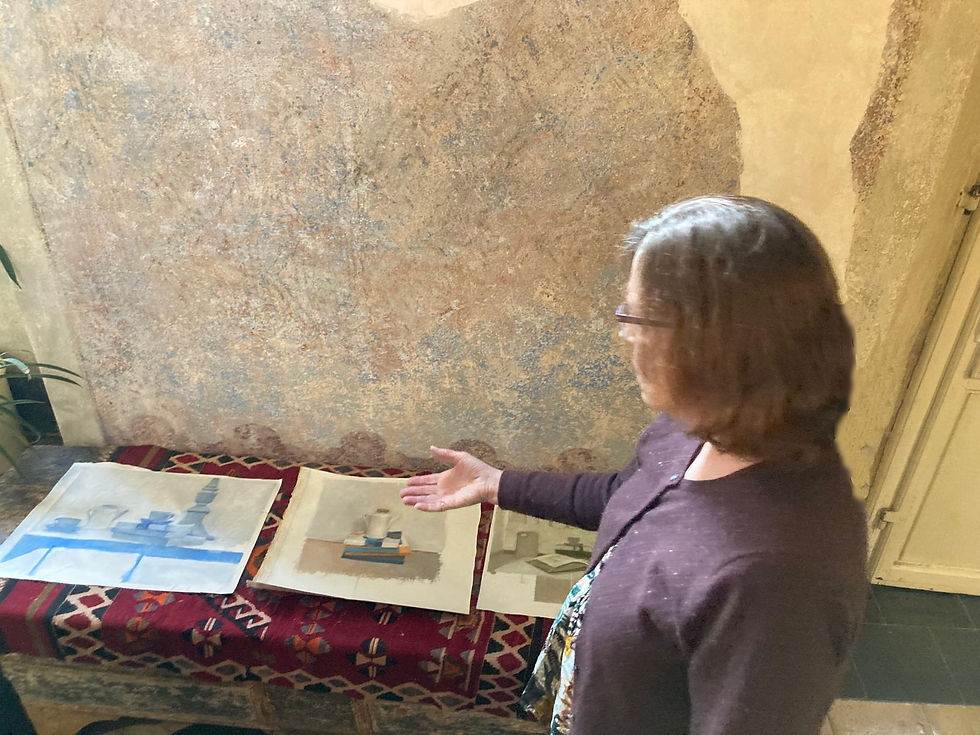
Pamela is an artist with a truly distinctive style, and her compositions draw primarily on the objects and environments of her everyday life. She approaches familiar items with an original perspective, transforming what many people would consider ordinary objects into subjects worthy of contemplation. Deeply inspired by the work of Georgio Morandi, the painter from Bologna who dedicated his life to translating the poetry and mystery of objects into visual form, she explores a similar sensitivity in her own practice. Like him, she is interested in revealing the quiet presence and subtle meaning hidden in simple things. Although Pamela considers herself a representational artist, she is not concerned with strict
photorealism. Instead, she seeks to reinterpret objects, emphasizing their emotional resonance. Her process of creation starts with charcoal sketches and then moves into oil paints on a canvas. As she develops her pieces, there is an anthropomorphism visible in her paintings that reflects an emotional connection with the subject. Each object takes on its own personality and mysterious, sometimes surreal, dramas are enacted in the paintings.
Pamela describes the main project she was working on at Il Palmerino as rather experimental: her artwork combined traditional printed books with digital technology like mobile phones and laptops. Objects are often arranged to convey certain feelings - for example, a sense of anxiety is transmitted by a book that is open and almost falling off the edge of a table. She explains to us how Il Palmerino has been a source of inspiration for this current project, “There are many interesting objects here, including a lot of books. Since I like to play with coincidence, I was happy stumbling upon the antique books and unique belongings and combining them with the digital tools of modern life. Even in charming and historic Il Palmerino, this combination of old and new technology is ever present.”


Comments